
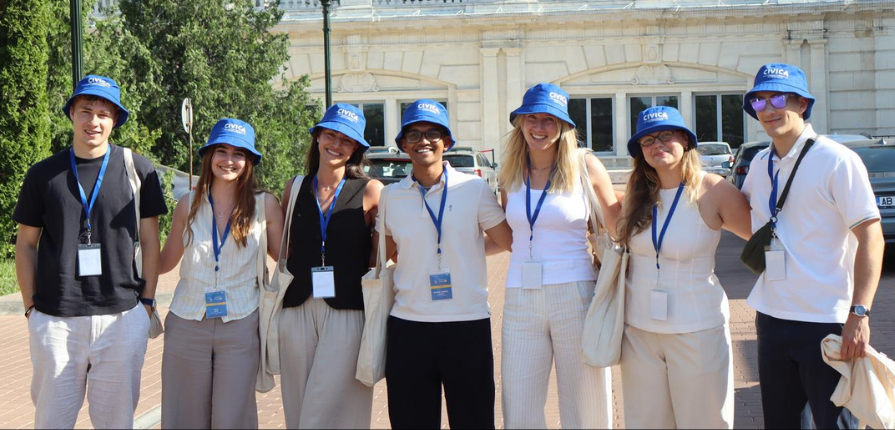
Each year, the CIVICA European Week brings together 100 undergraduate students from across the alliance. Working in inter-university teams, they explore local issues that reflect broader European challenges, learning from local innovators and experts along the way.
The week culminates in a pitch competition, where students present their ideas and solutions to a panel of academics, practitioners and community stakeholders, showcasing their creativity, collaboration and civic engagement.
The 2025 edition, hosted by SNSPA in Bucharest, was themed ‘Empowering Youth for an Inclusive Future’, a theme that resonated strongly with students from across Europe.
Among the participants were Fleur Caillé Méaulle from IE University and Erik Hillborn from the Stockholm School of Economics. In the reflections below, they share their unique takeaways; from satellite technology and EU sustainability policy to the cultural richness of Romania and the power of connection.
Exploring Policy, Place & History in Romania
For both Fleur and Erik, Romania’s capital city provided a compelling and meaningful setting for the week.
“We got to tour and meet people at the national area, and at the Palace of Parliament, one of the largest administrative buildings in the world and the heaviest building on earth!” wrote Erik, who noted how Bucharest’s urban landscape; neoclassical mansions, communist-era blocks, and modern skyscrapers, mirrored its layered history.
“Romania’s unique position… struck me,” Fleur reflected. “As an emerging market economy with relatively recent EU membership, it faces real disparities; especially in access to digital infrastructure and healthcare. But what I saw was a country full of energy and determination, with startups and institutions working hard to close these gaps and make the most of EU membership.”
This historical and social context helped frame many of the week’s academic discussions, from post-communist transitions to the EU’s evolving role in supporting resilience and inclusivity.
Tech & Sustainability: Policy in Practice
Fleur, studying Laws and International Relations at IE University, came to Bucharest eager to see how her academic interests, particularly in tech regulation and sustainability, played out in real-world discussions.
“My favourite panel discussion touched upon how satellites are being used for ecological monitoring; a perfect example of how emerging technology can serve environmental goals… The use of new technologies like MethaneSAT shows how cutting-edge innovation is becoming central to ESG commitments.”
She highlighted insights from Ioana Petrescu, ex-Finance Minister and European Climate Pact Ambassador to Romania, on Earth Observation Systems and how they are helping close gaps in environmental accountability.
Meanwhile, Erik had the chance to engage with these themes through his case study work.
“The case assignment I worked on was related to the biodiverse Danube Delta, largely located in Romania… We worked on this case in a group and received help from a mentor.”
Both students appreciated how the week combined academic learning with real-world applications, from field trips to casework.
Community, Curiosity & Connection
A defining element of CIVICA European Week is the opportunity to learn from and connect with peers across disciplines and countries.
“Beyond the academic insights, one of the most rewarding aspects of the week was connecting with people who share a genuine passion for shaping society through policy, sustainability, and digital governance,” Fleur said. “The fact that so many of our conversations naturally revolved around them was not only intellectually stimulating, but also a reminder that there’s a growing network of young thinkers across Europe committed to driving meaningful change.”
“There were many opportunities to connect with other people,” Erik agreed. “From students and faculty at other universities around Europe to policymakers, entrepreneurs, and locals in Bucharest. Meeting all these people was a highlight of the week.”
He also encouraged future participants to take full advantage of the social and informal learning moments: “For people already going I would recommend taking the time to connect with different people because that opportunity is definitely one of the primary things the program offers.”
A European Experience Worth Having
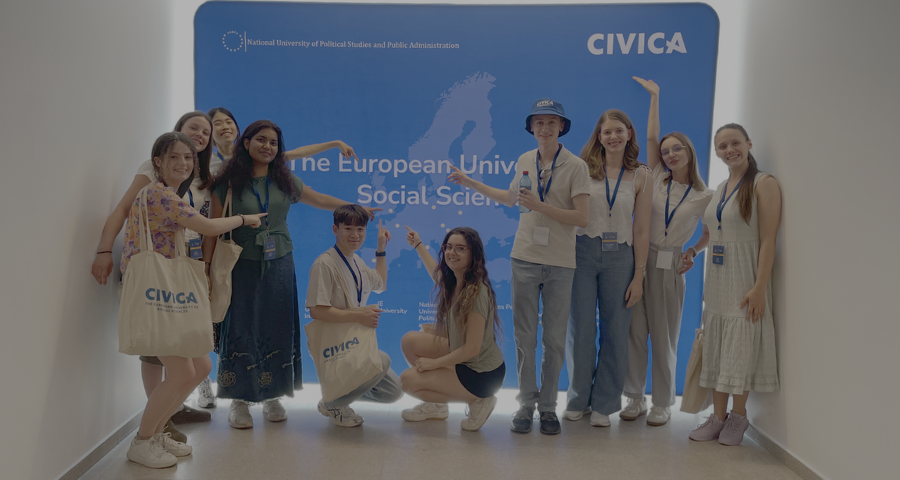
Both students walked away with new knowledge, new friends and a deeper connection to Europe’s shared challenges and opportunities.
“To anyone curious about the EU in practice, not just in theory, I’d say European Week is for you,” Fleur wrote. “It’s hands-on, intellectually rich and filled with brilliant minds from all over Europe.”
“I recommend the program to people who are excited to meet other people interested in [the social sciences],” Erik added. “There were people studying economics, history, philosophy, anthropology and many more.”
From academic panels to city tours, from deep policy dives to casual dinners, the week in Bucharest offered a chance not just to learn about Europe, but to live it.