
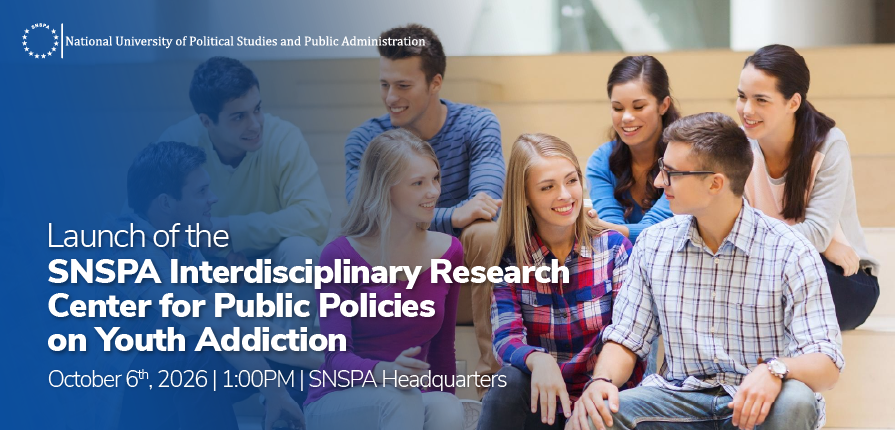
On Tuesday, 6 October 2026, the National University of Political Studies and Public Administration (SNSPA) will launch the Interdisciplinary Research Center for Public Policies on Youth Addiction. The event will take place from 1:00 p.m. at SNSPA’s headquarters, 30A Bd. Expoziției, ground floor, in the Multifunctional Room. Members of the SNSPA academic community are welcome to attend, subject to available seating. Please confirm your attendance by completing this online form.
The new SNSPA Center will support the development of applied research and strengthen cooperation among academia, public institutions, health and education professionals, non-governmental organisations, and international partners. In this context, SNSPA has invited American Councils for International Education to take part as a partner.
The official opening will be attended by Prof. Remus Pricopie, PhD, Rector of SNSPA, Prof. Mihai Păunescu, PhD, Vice-Rector of SNSPA and Interim Director of the Center, Lisa Choate, President and CEO of American Councils for International Education, Prof. Mihai Dimian, PhD, Minister of Education and Research, Prof. Daniel David, PhD, Rector of Babeș-Bolyai University in Cluj-Napoca, Assoc. Prof. Anca Petrescu, PhD, Vice-Dean of the Faculty of Psychology and Educational Sciences at the University of Bucharest, and Assoc. Prof. Florina Rad, PhD, President of the Romanian Association of Child and Adolescent Psychiatry and Allied Professions and Senior Specialist in Child and Adolescent Psychiatry.
The special guest of the event will be Mirabela Grădinaru, First Lady of Romania.
The event will continue with a panel discussion entitled “International Perspectives on Youth Addiction: Social Media, AI, Prevention, and Treatment.” The discussion will address emerging forms of behavioural addiction, the effects of social media and digital technologies on young people, family dynamics, prevention, and therapeutic interventions. It will also compare approaches in Romania and the United States, including the roles of schools, families, and mental health systems.
The event program is available here.
In Romania, youth addiction is a complex issue that extends beyond the use of alcohol, tobacco, and illicit substances. Excessive use of digital platforms, social media, and games, together with increasingly early exposure to technologies that may encourage compulsive behaviours, poses additional risks to young people’s mental health, emotional development, academic performance, and social relationships.
Social media addiction also has a civic dimension: it can shape how young people perceive social realities, access information, form opinions, and participate in democratic life. Addressing this issue therefore requires connecting its psychological aspects with the analysis of social behaviour, information consumption, political socialisation, exposure to manipulation, and the effects on civic participation and democratic citizenship.
Responding to these challenges requires relevant data and coordinated interventions tailored to the realities young people face. Without an integrated approach, prevention, treatment, and recovery measures risk remaining fragmented and insufficiently responsive to their needs.
The Center’s work will include studies on the scale, causes, and development of addiction, the collection and analysis of relevant data, the evaluation of existing programmes, and recommendations to inform public policy. Its research will also examine the links between the psychological dimensions of addiction, social behaviour, information consumption, political socialisation, exposure to manipulation, and civic participation. The Center will also develop models for early prevention and integrated intervention, as well as information campaigns, conferences, discussions, and training programmes.
By launching this new structure, SNSPA is establishing an academic and institutional framework dedicated to understanding addiction among young people and translating research findings into concrete solutions for prevention, support, treatment, recovery, and social reintegration. The complexity of this phenomenon requires an interdisciplinary approach and sustained cooperation among higher education institutions, drawing on expertise from complementary fields. Developing such partnerships is essential to shaping integrated and effective responses to the challenges posed by youth addiction.