
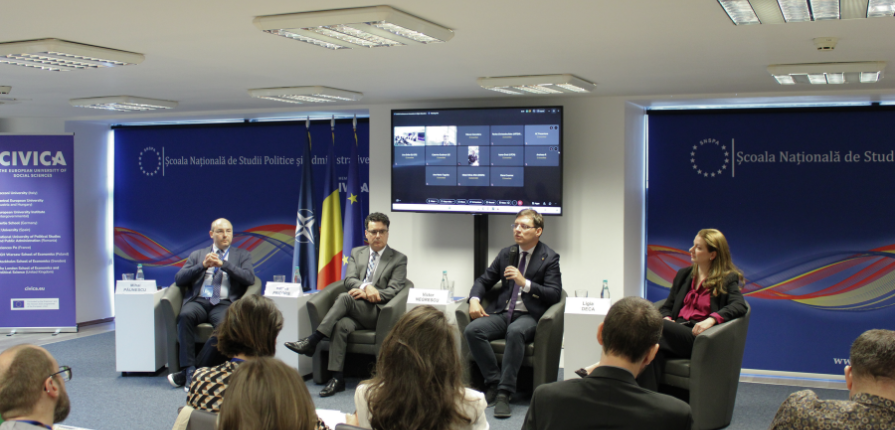
On Friday, 29 May 2026, the National University of Political Studies and Public Administration (SNSPA), a member institution of CIVICA – The European University of Social Sciences, hosted the “CIVICA Conference on Innovation in Higher Education”. The event took place in a hybrid format, at the SNSPA headquarters on Bd. Expoziției no. 30A and online, bringing together academics, students, young researchers, as well as experts in higher education and public policy.
The conference was opened by Professor Remus Pricopie, PhD, Rector of SNSPA; Victor Negrescu, Vice-President of the European Parliament and faculty member at the SNSPA Department of International Relations and European Integration; Professor Adrian Curaj, PhD, President of the SNSPA Senate and Director General of the Executive Agency for Higher Education, Research, Development and Innovation Funding (UEFISCDI); Lecturer Ligia Deca, PhD, Secretary-General of the Romanian National Commission for UNESCO and Vice-Rector of SNSPA; and Professor Mihai Păunescu, PhD, Vice-Rector of SNSPA. Their interventions highlighted the importance of European academic cooperation, innovation in higher education, and the development of flexible educational models capable of responding to current social, technological and economic transformations.
The event featured presentations by Claire Gordon and Rebecca Sealy, representatives of the London School of Economics and Political Science; Francisco de Abreu Duarte, faculty member at the European University Institute; and Pușa Năstase, Visiting Professor at Central European University. The topics addressed included lifelong learning models, the use of new technologies in teaching, including the role of avatars in education, as well as micro-credentials and innovative teaching formats developed within international academic initiatives.
Organised as part of CIVICA’s initiatives dedicated to strengthening a shared vision of the European university of the future, the conference provided a framework for reflection and dialogue on how universities can adapt teaching, training and academic cooperation processes to the profound changes shaping contemporary society. The discussions emphasised the role of social sciences education in preparing new generations for an increasingly dynamic, interconnected professional environment, strongly influenced by technological developments.
The conference programme also included two roundtables dedicated to the future of the CIVICA alliance, policy recommendations for the development of European university cooperation, as well as innovation, lifelong learning and the teaching of social sciences.
By organising this conference, SNSPA reaffirms its commitment to the development of the European Education Area and to the promotion of innovative academic practices capable of responding to the challenges of a constantly changing world. The event contributed to strengthening dialogue among universities, European institutions, experts and social partners, as part of a common effort to rethink the future of higher education.
CIVICA – The European University of Social Sciences currently brings together ten leading institutions in the fields of social sciences, humanities, business management and public policy: Sciences Po (France), Bocconi University (Italy), Central European University (Austria), European University Institute (European intergovernmental organisation), Hertie School (Germany), SNSPA (Romania), Stockholm School of Economics (Sweden), IE University (Spain), SGH Warsaw School of Economics (Poland), and the London School of Economics and Political Science (United Kingdom).